Monday, October 8, 2012

This History Repeated Is Unpaid Attention To News

October 2, 2012 - Prison Reform - 

Letters written by New York State prisoners sent to New York Civil Liberties Union over several months vividly detail the psychological effects of long-term solitary confinement.
As free people the worst punishment imaginable is the loss of the freedom to decide where to go. I’ve spent two separate nights in jail and know you become complacent accepting your waiting in the cell. But when you know you’re out soon, the level of hope has to be much greater than for those rotting in prison. A world away from cooling your heels for a night.
I just feel having your liberty taken away is punishment enough. How is our anger mollified if their entire lifestyle reflects our anger with them on a continuous basis? Sure bunks in a cell is efficient, but we’ve found so many ways to make that experience expensive, what’s the difference giving them a little space? I remember a European documentary describing a prison operated like a dormitory with rooms and the basic conveniences of modern life that didn’t seem so much like punishment. The person could go to work, but not where they wanted.
The New York Times reports on an aspect of how much punishment is enough, under the title Prisoners’ Letters Offer a Window Into Lives Spent Alone in Tiny Cells By MOSI SECRET. The Times describes how - The handwritten letters arrived by the dozens, from men who described in flawed but poignant language what it was like to lose their minds.
One man wrote, “I feel like I am developing some kind of skitsophrinia behaviors. I hear voices echoing as I try to fall asleep.” Another said his mind “rots” with “thoughts that are uncommon or unnatural and you wonder where the hell did that come from?”
Continuing The Times states - They are prisoners in New York’s state prison system and were convicted of a range of crimes, including selling drugs and murder. The men were ordered out of the general prison population and into solitary confinement— or, in their parlance, “the box”, where they lived in tiny, elevator-size cells cut off from almost all human contact. The reasons varied: fighting, smoking, testing positive for drugs. But often for more serious crimes, like stabbing other inmates, trying to escape or attacking guards.
The Times draws a vivid picture. - Having been held captive to their imaginations for weeks, months or, occasionally, years on end, the men, many already struggling with mental illness, brought their paranoia, rage, anxiety and hope to life on the page, with descriptions that were sometimes literary and other times nearly impossible to decipher. More than anything, they conveyed a grisly awareness that their identities were unraveling, a feeling so disconcerting for some that they tried to take their own lives.
The Times prints - The trove of letters from more than 100 inmates to the New York Civil Liberties Union, which corresponded with the men to bolster its attempts to curtail the practice of solitary confinement, gives new insight into a closed-off world usually viewed only one person at a time. The letters may add fuel to the national debate over whether holding prisoners in extreme isolation amounts to cruel and unusual punishment. Many states have recently shifted away from the practice, which was the subject of federal hearings this summer, but it remains widespread in New York.
I’d imagine anywhere two politicians could rubbed together is sufficient to go through the farce of portraying the defense of law and order, no matter how vindictive the punishment actually appears. Apparently when authority withholds wielding extreme amounts of power it can’t feel the heft of its own weight. So like corporations the Supreme Court grants individual rights, so too must we respect the right to punish to the full extent of the law whether it’s just for punishment’s sake or not. So I can assume their individual prison cells don’t lock? We control prisoners to a degree like children their supervisors are responsible for. So why not just make them stay in their rooms/cells? Miss that hour a day walk that, too a degree, is cruel and inhuman punishment too.
The Times calculates - Nearly 4,500 prisoners in the state are held in segregated housing on any given day, about half in solitary confinement and half in cells with another inmate, according to the N.Y.C.L.U., which planned to publish a 72-page report on its findings on Tuesday, a copy of which was provided in advance to The New York Times.
Sounds daunting to even crack the seam, but one can wonder how many in the prison system should have it assigned to them as required reading before they complain we don’t understand how much retribution the victims of the criminals deserve and how unworthy of our care criminals are.
Quoting - The civil liberties group - The Times - called both types of segregation “arbitrary, inhumane and unsafe,” arguing that corrections officials have too much discretion to send inmates to segregated housing for long periods, even for minor infractions.
Is it a wonder convicts, and inevitable convicts, see punishment in civilian life a reward in itself for themselves, after being molded into degenerates living out society’s extremes.
The Times says - The report does not call for abolishing solitary confinement but recommends that the state corrections department enact more restrictive regulations that reserve isolation as a punishment for the most violent offenders and that the state take a census of its cells to find out which inmates deserve to be there.
See, there goes politics. Chipping away at the status quo, prolonging just plain turning everything around.
The Times cites - A spokesman for the corrections department, Peter K. Cutler, who limited his comments in an interview on Monday because the report had not been released. Mr. Cutler said, “Disciplinary segregation is something that we take very seriously in our system.” Then The Times paraphrases, printing, - He said the factors guiding the department were inmate behavior and the safety and security of the prisons. “There is a process. It is not something that is done unilaterally.”
Sanitariums used to pick out the worst and give them lobotomies too. So?
Donn Rowe, president of the New York State Correctional Officers and Police Benevolent Association, said, “Inmates are absolutely entitled to rights, and should never be subjected to violence. But their anonymous complaints should also be met with an appropriate amount of skepticism, and the public must be reminded that New York’s prison system houses some of the most violent and troubled individuals in this country.”
So why try to teach them compassion? They’ll never learn so why be compassionate toward the worst of us? Our only option is tearing their ill will apart when that’s what made them who they are?
Maybe The Times erred in not giving authority the last word? But prints nonetheless - In the letters, the inmates, whose real names were not released by the N.Y.C.L.U. because the organization said they might suffer retribution from corrections officials, accepted responsibility for the crimes that they had committed on the outside but questioned whether their behavior on the inside deserved such treatment. They pointed fingers at the mental health officials, nurses and guards who they said brushed off complaints.
The efficacy of being damned to mortal punishment is all that can be seen from the inside of a prison?
Wrote a man who would try to commit suicide months later, “Please, somebody help. I need HELP!!!”
But the inmates are transferred to segregated housing after breaking the rules. One said he was cited for “wreckless eyeballing and stalking” after he looked at a female prison guard’s backside as she bent over to pick up her keys.
God forbid prison be at all similar to the real world outside, huh?
Most of the men ended up at one of the two state prisons dedicated entirely to isolation cells, Upstate Correctional Facility, in the town of Malone near the Canadian border, or Southport Correctional Facility, in Pine City. Monotony was the rule for 23 hours a day. They received their food through slots in the doors. For one hour each day, they exercised in a small metal cage called the “kennel.”
Shouldn’t there be a law protecting dogs’ rights not to have words associated with them demeaned?
Yes I would expect prison officials to know anyway but The Times, as usual to look informed, tattles on the prisoners printing - The men “fished,” or passed notes, books and magazines to each other using ripped sheets weighted by toothpaste tubes. But mostly they watched the walls.
One inmate wrote, quotes The Times, “The water from the sink is a milky color. It’s not white but its definitely not clear. Our shower is extremely hot and drips even after we cut it off — nonstop. Due to the moisture from the shower and the sink, we now are beginning to notice knats, also known as ‘fruit flies.’ The walls are marked with gang signs, demonic drawings, mucus, feces and rust. We are not allowed to disinfect our cells. There is toothpaste hard and flaky on my lights, walls, bed, ceiling, doors and vents. On my shower there is numerous stickers, mildoo, soap residoo, and what appears to be little spots of dried blood.”
Really? Are our paid employees being lazy about prisoner hygiene punishment enough? Or is it true we’ve figured out how to put all our slobs away for life?

Maker Faire Celebrates Affordable Future Now


Our evermore increasingly intriguing world takes for granted that everything seems within our grasp now for just a few dollars more. So much code is already installed in our computers, that using them on a user-friendly basis, even the most naive are capable of outstanding accomplishments. As NPR’s Stan Alcorn reported, “what professionals use is now affordable for amateurs.” For a relatively small amount of money we’re all in one way or another functioning in a worldNASA used to spend billions on for a few to participate in while we watched.
And Maker Faire, hosted this past weekend by the New York Hall of Science in Queens, is all about how no one has to be satisfied watching anymore. Whatever can be manufactured within reason, and who could really know that limit, can be done all by ourselves if we only learn to teach ourselves how.
I’ve been told exhibitors at trade shows really enjoy sharing what they sell. But Maker Faire turns that up a notch as their hearts are in relaying what you can create on your own. Harkening back to Aldous Huxley’s warning in his novel Brave New World that if we allow everything to be provided for us we’ll no longer have our own lives. Yet Maker Faire is not so ominous. Their message is how fun making things is that Business Insider shows in a photo montage.
Sherry Huss and Dale Dougherty and Mayor Bloomberg’s Maker Week Proclamation that was apparently sincerely written by the mayor himself.
policymic.com provides an extensive review of the event.
And finally how curious are you about 3D Printing? Phenomenal to watch what only a short time ago was just imagination.


The Queens Crew

The Great Hall at Cooper Union Introduction of Fifth, Park and Madison


September 28, 2012


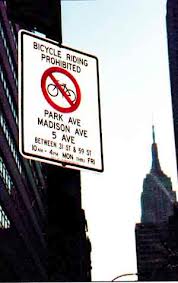
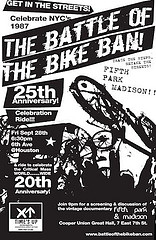
The following was my introduction of Fifth, Park and Madison at the 25th Anniversary celebration of The Battle of the Bike Ban in The Great Hall at Cooper Union, Manhattan, New York City, New York, U.S.A., September 28th, 2012.


The Preamble: While humanity slowly woke to protecting our Earth, the bicycle contributed since the 19th Century.

Thank you for coming rain or shine - like a bike messenger. The artist Dragan Ilic videotaped all of Fifth, Park and Madison during the street protests of August, 1987. With interviews from a scheduled, but informal, forum and Labor Day Parade, plus street footage of couriers demonstrating for Dragan how they rode the avenues.

The documentary premiered, that October, a stone’s throw from here, at a short-lived downtown film and video festival. Across from The Public Theater in the basement of 432 Lafayette Street on Colonnade Row.

Art historian Alan W. Moore, who preserved this original copy, is right describing it a document. A slice of life, from a period of time, whose authenticity even makes me not regret that I didn’t put everything in.

Dragan found real jewels that made this documentary. So thanks to him, I welcome all of you to my little bike messenger’s interpretation of history.


receives all proceeds from your viewing this free documentary. 
TIME'S UP
I apologize for the poor resolution of the event's program as I found this copy after realizing the event's website is down when I should have anticipated being of insufficient commercial value.
For more on the subject of bike couriers
___
From author Sydney Schuster, a comprehensive 1987 article on the bike courier profession, HELP WANTED/The Myth of the Mighty Bicycle Messenger including the web-link to 
Cheetah: The Nelson Vails Story
_________________________
The Couriers' Friend, Rogers Simon


25 Years After Ed Koch’s Proposed Bicycle Ban, Cyclists Have Gained Much Ground


en.wikipedia.org
Bicycle courier, London, UK, riding a fixed gear
Colonnade Row 


Peter Cooper

September 25, 2012 - United Nations General Assembly - Confusion Between Justice And Revenge Remains In American President’s Conciliatory U.N. Speech


Full text of the U.S. President‘s speech, before the UN, can be found at the National Journal.
Under The New York Times headline, In U.N. Speech, Obama Warns Time Runs Short on Iran By HELENE COOPER it was noted - President Obama challenged the Arab world to use its newfound embrace of democracy to ensure protection for freedom of religion and speech and even life, using the last address of his first term to the General Assembly on Tuesday to call for a renewed focus on the “painstaking work of reform.”
The Times states the 800 lb. Gorilla on the planet is being faced, printing - Mr. Obama took on a number of issues at play between America and the Muslim world, vowing that the “United States will do what we must to prevent Iran from obtaining a nuclear weapon” and warning that time to diplomatically resolve the Iranian nuclear issue “is not unlimited.” But he refused to go further than what he has said in the past, that “a nuclear-armed Iran is not a challenge that can be contained,” despite pleas from Prime Minister Benjamin Netanyahu of Israelto establish a new red line.
Though not repeating himself at the U.N. hardly connotes refusing to say what he’s said in the past and ignoring pleas from the Israeli Prime Minister to establish a new red line. On one hand The press can reduce leaders to mere rhetoricians and on the other run the chest-thumping into the ground themselves. All basically blamed on the public’s limited ability to delve into issues, while wanting their political entertainment served on a digestible platter. So to speak.
The Times quotes Mr. Obama saying, “America wants to resolve this issue through diplomacy, and we believe there is still time and space to do so. We respect the right of nations to access peaceful nuclear power, but one of the purposes of the United Nations is to see that we harness that power for peace.”
The Times continues - But he spent most of his 30-minute speech on the Arab democracy movement and its fallout. Just two weeks after the beginning of violent anti-American protests that led to the killing of four Americans in Benghazi, Libya, Mr. Obama vowed that even as the United States works to bring the killers to justice, he will not back down from his support of democratic freedoms in the Muslim world. But he also gave a spirited defense of American freedom of speech and the spirit of tolerance that allowed the inflammatory anti-Muslim video that prompted the protests.
Yes. Pats on the back are well deserved.
Mr. Obama said “As president of our country, and commander in chief of our military, I accept that people are going to call me awful things every day. And I will defend their right to do so.” For that, he received cheers in the cavernous hall.
But - While condemning the “crude and disgusting” video that prompted the protests in Libya and throughout the Muslim world, the president worked to explain, before a sometimes skeptical audience that has never completely bought into the American idea that even hateful speech is protected, why the United States values so highly its First Amendment.
A mouthful for The Times, yet addressing reality as the president seems to do.
President Obama said “We do so because in a diverse society, efforts to restrict speech can become a tool to silence critics, or oppress minorities. We do so because given the power of faith in our lives, and the passion that religious differences can inflame, the strongest weapon against hateful speech is not repression, it is more speech — the voices of tolerance that rally against bigotry and blasphemy, and lift up the values of understanding and mutual respect.” Americans, he said, “have fought and died around the globe to protect the right of all people to express their view.” And pointedly said, “there is no speech that justifies mindless violence. … no words that excuse the killing of innocents. There is no video that justifies an attack on an embassy. There is no slander that provides an excuse for people to burn a restaurant in Lebanon, or destroy a school in Tunis, or cause death and destruction in Pakistan.”
The Times states - It was the president’s first truly expansive response to the anti-American protests over the American-made video, and it came at a politically fraught time, just as his campaign is battling attacks from his Republican challenger, Mitt Romney, that Mr. Obama has projected weakness abroad, a charge the Obama campaign has vociferously disputed.
So, as it should be - Traffic-clogged New York was the scene on Tuesday of dueling speeches from Mr. Obama and Mr. Romney. Mr. Romney spoke first at the Clinton Global Initiativeabout development, and managed a smile when former President Bill Clinton, a recent Obama surrogate, jogged onto the stage after his remarks to thank him. Mr. Obama spoke in the afternoon.
While at the UN the president said, “I would like to begin today by telling you about an American named Chris Stevens, in a somber reference to the American ambassador to Libya who was killed with three other Americans two weeks ago during the attack on the American diplomatic compound in Benghazi. Mr. Obama spoke of Mr. Stevens’s “love and respect” for the people of North Africa and the Middle East, of his penchant for “walking the streets of the cities where he worked, tasting the local food, meeting as many people as he could, speaking Arabic and listening with a broad smile.”
And at the close of his remarks, he returned to Mr. Stevens, who was well known to many of the diplomats gathered before him. “Today I promise you this, long after these killers are brought to justice, Chris Stevens’s legacy will live on in the lives he touched. In the tens of thousands who marched against violence through the streets of Benghazi; in the Libyans who changed their Facebook photo to one of Chris; in the sign that read, simply, ‘Chris Stevens was a friend to all Libyans.’”
And so it goes, rightfully so, that the tragic killings not be ignored. But, still, calling for justice is beating the drum of vengeance that got Mr. Stevens killed no matter what details come to light. Either we all grow up together or our cultures will not grow up at all.

September 22, 2012 - Noted Stalin Biographer Runs Down Historical Parallels To Journalist Masha Gessen’s Phone Call From President Putin


Under The New York Times headline, Please Hold for Mr. Putin,SIMON SEBAG MONTEFIORE adds some historical perspective to a recent firing over editorial integrity.
First, what’s funny on initial glance is Ms. Gessen’s phone is tapped and intermittently shut off, and President Putin dials her up through a secretary as if shooting the breeze with a critic is routine. Keep this cool. After all America spent decades fighting corruption and, in the end, it’s the legal varieties that stab our best intentions in the back anyway. And yes, I hardly believe myself either. But certainly centuries of experience have proven the only solution is the evolution of the criminal class, when it no longer pays to deceive.
So the American/Russian journalist, MASHA GESSEN, fairly-objectively recounts in Flying Putin, Fired Editor her recent firing for refusing to send a reporter to cover President Vladimir V. Putin’s hang-glider flight. Then Mr. Montefiore writes - Last week she received an unexpected phone call. She said, “My phone rang. … I listened to silence for two minutes.” Finally: “Don’t hang up. I will connect you.” Frustrated, Ms. Gessen shouted: “Do you want to introduce yourself?” A famous voice replied: “Putin, Vladimir Vladimirovich. I heard you were fired and that I unwittingly served as the reason for it.” He invited her to meet.


Ms. Gessen was flummoxed: “But how do I know this is not a prank?”
Mr. Montefiore speculates - Educated Russians would have spotted similarities between this call and earlier Olympian interventions into the lives of writers by Romanov and Communist autocrats, illuminating rituals of Russian leadership and the relationship between power and art. This tradition flatters the writer in a culture where literature has special prestige. But the surprise also promotes the cult of the unpredictable czar who moves, like God, in mysterious ways.
And Mr. Montefiore continues - Eighty-two years ago, Mikhail Bulgakov, novelist and playwright, had been fired from Soviet theaters, his works banned, when his phone rang: “Comrade Bulgakov? … Please hold. Comrade Stalinwill speak to you.” Then the famous voice began, “I apologize … we shall try to do something for you.” Afterward Bulgakov phoned the Kremlin: was it a prank? It was Stalin. Soon, the theater employed Bulgakov again. Unpublished nor produced but allowed to live.
In May 1934, the poet Osip Mandelstam was arrested for a poem mocking Stalin. His fellow poetBoris Pasternak tried to help. His phone rang. Stalin: “Mandelstam’s case is being reviewed. Everything will be all right. … He’s a genius, isn’t he?” Pasternak: “But that’s not the point.” He said he wanted to talk “about life and death.” Stalin rang off. Pasternak phoned the Kremlin, asking Stalin’s secretary if he could tell others about the conversation. Yes, he could.
Tidbits in lieu of the freedom to tell Stalin to ____ himself. Come on President Putin, don’t let your legacy be a part of his.
Mr. Montefiore is not done despite a newspaper’s limited space. - March 1949:the composer Dmitri Shostakovich refused to represent the U.S.S.R. abroad. Stalin rang: Shostakovich said he wouldn’t join a Soviet delegation when no Soviet orchestra performed his work. Stalin: “Why don’t they play it?” It was banned by censors. Stalin: “We didn’t give such an order. I’ll have to correct the comrades.”
Always someone else responsible for the mistakes, right Vladimir, sir?
Mr. Montefiore goes - Even further back, 1826: Nicholas I, after crushing theDecembrist rebels, invited their exiled supporter, the poet Aleksander Pushkin, in for a chat. The czar appointed himself Pushkin’s censor and declared, “Today I had a conversation with the cleverest man in Russia.” Pushkin told everyone about Nicholas’s charm.
Stalin was channeling Nicholas; Putin channeled both. Nicholas I has been called “Genghis Khan with a telegraph.” Stalin was “Genghis Khan with a telephone.” But Mr. Putin is not Genghis Khan with a BlackBerry. Those Russias were dominated by the missions of Orthodox czardom and homicidal totalitarian Marxist-Leninism; today’s Russia is authoritarian but still freer.
Mr. Montefiore, now is that freer when government indiscriminately leaves you alone? Or free from government on your back? Freer than years past, no doubt, but the deterioration of something that wasn’t quite established is obviously frustrating to people who’ve been treated asproles for too long.
Mr. Montefiore describes Stalin - Physically awkward, with one shorter arm, once a published poet, was half murderous tyrant, half intellectual, always reading. He was fascinated by literary genius: half of his huge library is said to sit in the president’s Kremlin office. Mr. Putin’s interest seems more utilitarian. He prefers Tarzanian displays of bare-chested, tiger-whispering environmentalism. But he still may have learned something from those books.
And evidently Mr. Montefiore is trying encourage President Putin. - Russian writers enjoy almost sacred status. Mandelstam reflected that poetry was so respected in Russia, “people are killed for it.” He perished in the gulag. Under Stalin, artists weren’t dissidents; all they hoped was to survive and write. Today’s Russia is still worryingly unsafe: journalists have been assassinated, oppositionists beaten, the punk protesters Pussy Riotimprisoned. So Ms. Gessen showed courage at her presidential encounter: when offered her job back, she refused to be a “Kremlin appointee.” Ms. Gessen gave a full accounting of the call and meeting in a blog post forThe International Herald Tribune, The Times global edition.
So Mr. Montefiore asks - why, really, do these czars make the call? The outcome of the conversation is irrelevant. (In Ms. Gessen’s telling, faced with an issue, Putin blew her off in person.) The point isn’t the call itself but the myth of the call, spreading like ripples in the pond of the intelligentsia. (That’s why Stalin’s secretary told Pasternak he could recount the story.) It showed the president had heard of Ms. Gessen’s plight and reached down, with imperial magnanimity, to a hostile writer to correct an injustice. He was also able to prove that though he may have been mocked for his adventures — when it emerged that a tiger he “captured” was from a zoo and that ancient amphorae he “discovered” on a dive were planted — he was not deceived. “There are excesses,” he admitted jovially, but only in the cause of saving nature. His candor, thus reported by Ms. Gessen, disarmed ridicule. The good czar showed he despised the preposterous sycophancy of his pettifogging officials just like ordinary Russians did. He saw all. He knew.
Today’s oppositionists are bloggers, not poets, but an autocrat of the Internet age still paid a compliment to the old-fashioned written word. As Bulgakov wrote, “Manuscripts don’t burn.”
Words alone can shine, that can’t be decreed.
SIMON SEBAG MONTEFIORE is the author of Stalin: The Court of the Red Tsar and Jerusalem: The Biography.